Sushi|Bar, Reconsidered: The Evidence Is Even Stronger

Nearly a year after my first visit to Sushi|Bar, I returned with a legitimate concern. Could an experience built around surprise remain exciting once it was no longer entirely new? Worse, had success invited complacency? At this price point, repetition is not inherently disqualifying, but any decline in quality certainly would be.
The verdict is emphatic. Everything was excellent, several courses were magnificent, and the entire experience remained world class.
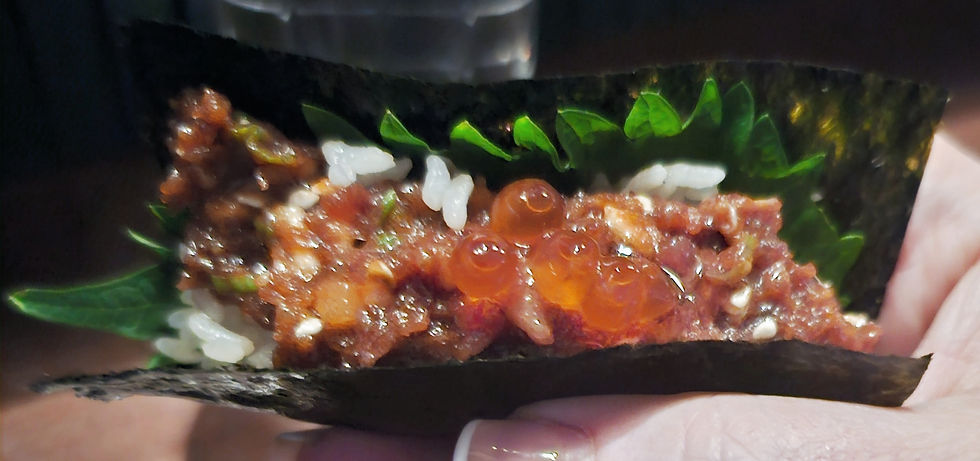
The opening tartare handroll immediately established the standard. The nori was perfectly crisp, with tuna, rice, sesame, ikura, and a shiso leaf tucked inside. The seasoning elevated the fish without covering it. That distinction matters. Too many elaborate preparations use sauce and garnish to conceal unremarkable seafood. Here, every added element served the fish.
Shima aji followed with Meyer lemon and a dash of Fresno chile. The combination was bright and punchy but sufficiently restrained to preserve the clean richness of the striped jack.

The madai was simply perfection.

Then came the bafun uni, harvested from Japanese short-spined sea urchin. I have now concluded that this is the only quality of uni worth eating. It was deep orange, beautifully intact, spectacularly buttery, and possessed none of the unpleasant low-tide character that inferior uni can inflict upon the unsuspecting. If excellent bafun uni is unavailable, I am prepared to exercise restraint and eat something else.

The akami was gorgeous, with the deep, pure flavor that lean tuna should have when quality and freshness leave the kitchen nowhere to hide. [N.B., I was too excited by this point to remember to take a picture of this gorgeous bite.]
Then came the hotate. My God, the hotate. Some dishes are excellent because you can identify every element and admire how intelligently they work together. This is something else. This is the rare bite that bypasses analysis and produces an involuntary response. The scallop comes from the bitterly cold Sea of Okhotsk, just north of Hokkaido, where the frigid water helps produce its extraordinary sweetness and melt-in-the-mouth buttery texture. Sushi|Bar pairs it with a seaweed compound butter made with Maison Bordier butter from Brittany, France. The butter is worked by hand using traditional techniques and incorporates seaweed gathered from nearby beaches. Purple shiso blossoms, or hanaho, finish the piece.
That description explains the ingredients. It does not explain what happens when you eat it.

A birthday boy next to us tasted it and said, “Holy fuck.” His lovely companion managed only, “Oh my God.” Sean, the sommelier, told us that the first time he ate it, he cried. I understood all three reactions. I have spent nearly a year eating my way through Charleston and beyond, trying to find a better bite. I cannot.
The scallop is naturally sweet and almost impossibly tender. The seaweed butter deepens its oceanic character without making it heavy, while the tiny shiso blossoms contribute just enough fragrance and delicacy. Every component is discernible, but none calls attention away from the scallop. Instead, the preparation makes the hotate taste even more completely like itself.
For one bite, the entire counter stopped being a collection of strangers having dinner. We were simply people astonished by the same beautiful thing. That is the magic of it. Among the seventeen courses served that evening, the hotate remained the best bite. Nearly a year later, it is still the single best bite I have ever found. We all needed a cigarette after that bite.
Ora King salmon followed, lightly smoked with applewood. The smoke remained a suggestion rather than becoming the dominant flavor, enhancing the salmon’s buttery richness without turning it into conventional smoked salmon.

Sawara arrived with toasted sesame salt, and I attempted to take Noel’s piece after finishing mine. She declined to surrender it. This was selfish of her but understandable.

Hamachi is not normally among my preferred fish, yet this preparation was excellent. The kitchen thoughtfully omitted the pineapple from my piece, and nothing felt missing or diminished. The fish and preparation stood firmly on their own.
Kinmedai is my favorite fish, so Chef Max was operating under strict scrutiny. He explained that this deep-water species is found roughly 2,000 to 4,000 feet below sea level. Life at those depths produces a beautiful layer of fat just beneath the skin, giving the fish its distinctive buttery texture and deep umami character. That was already everything I wanted. Then he announced that he had topped it with freshly grated wasabi, shiso pesto, and toasted pistachio salt. I was immediately suspicious. Kinmedai needs very little help, and shiso pesto with pistachio salt sounded like an excellent way to obscure everything that makes it my favorite fish. I was fully prepared to have Chef Max jailed for crimes against kinmedai. Instead, he proved me wrong.
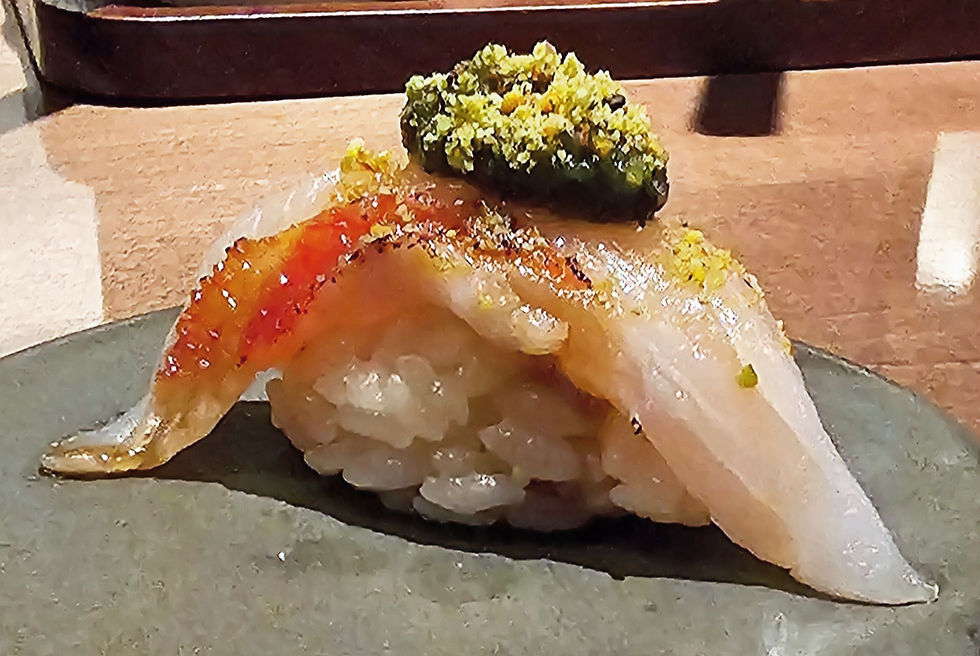
The wasabi sharpened the fish’s richness, the shiso pesto added a vivid herbal note, and the toasted pistachio salt contributed savoriness and texture without masking the delicate flesh. Every addition enhanced the kinmedai rather than distracting from it. The preparation was unexpected, intelligent, and beautifully controlled. I finished it and immediately wanted another. Objection withdrawn.
The otoro was gloriously excessive: rich tuna belly with tamari, Osetra caviar, wasabi, and a touch of salt. It was also beautifully proportioned. Each luxurious component remained distinct while contributing to the whole.

Bincho followed in tataki style with a Thai dipping sauce and fried, candied garlic. The brighter, leaner preparation provided a welcome contrast after the opulence of the otoro. The sauce made the course exceptionally bright, while the candied garlic added sweetness and crunch.

The chutoro landed exactly where it belonged between the lean akami and the lavish otoro. It had enough marbling to provide richness without losing the clean, concentrated character of the tuna. Most importantly, it was impeccably fresh. Chef Max’s explanation of the progression from akami through chutoro to otoro transformed three excellent pieces of tuna into a lesson in anatomy, texture, and fat.

Zuwaigani, Japanese snow crab, was delicate, sweet, and thoroughly tasty. The optional shaving of Australian black truffle made it even better, adding earthy depth without obscuring the crab.

I do not ordinarily lose my mind over wagyu. This A5 wagyu came from Miyazaki Prefecture, whose beef earned Japan’s Prime Minister’s Award at three consecutive national Wagyu competitions. It arrived topped with beurre blanc foam and freeze-dried kimchi, which brought acidity, tang, and texture to all that extravagant marbling. My contemporaneous tasting note was “OMG,” although the unedited version contained an additional letter. I do not generally prefer wagyu, but this was amazeballs. You could taste the victory.

The savory progression concluded with unagi that had been braised and glazed with kabayaki, then finished with fermented jalapeño kosho, rendered bone marrow, caramelized shallots, and fresh chives. It sounded perilously rich. Eel already possesses its own soft, fatty sweetness, and adding bone marrow could easily have buried it. Instead, the marrow made the course extraordinary. The kabayaki supplied its lacquered sweet-savory depth, the caramelized shallots reinforced that sweetness, and the fermented jalapeño kosho cut through all that richness with heat and acidity. Fresh chives provided the final sharp, green note. The eel remained unmistakably at the center of the bite, but every surrounding element made it deeper, fuller, and more compelling. The bone marrow took it to another level and gave an already exceptional meal a closing course worthy of everything that preceded it.

Dessert combined panna cotta, matcha, white-chocolate-coated puffed rice, and yuzu ice. The creamy panna cotta, tart frozen citrus, gentle matcha bitterness, and crisp, sweet-coated rice played against one another beautifully. It was refreshing enough to reset the palate after the bone-marrow unagi but still felt like a composed and satisfying final course rather than the obligatory sweet thing served after the serious cooking was finished.

Sushi|Bar continues to justify its price by sourcing exceptionally fresh seafood, much of it from the Pacific, and treating it with both imagination and discipline. The kitchen is still capable of surprising returning guests without chasing novelty for its own sake.
The experience extends beyond the food. Sean remains charming and genuinely helpful, particularly when guiding guests through sake selections for the tasting. Because I do not drink alcohol, the team also arranged for a special lavender lemonade from my friend DJ at the Bellrose Hotel Bar next door. It was precisely the sort of personal hospitality that makes an expensive dinner feel special rather than merely luxurious.
The sweetest part of the night, however, was watching a young couple celebrate a thirtieth birthday with their first omakase. We watched them experience their first hotate and their first Osetra caviar, discovering course by course the things I already knew and loved. Their delight made the familiar feel new again. They were such good kids, and it was impossible not to enjoy watching them learn to love the things I already love.
Chef Max presided over the meal with quiet confidence. He explained the fish, its sourcing, and each preparation without turning dinner into a lecture or making first-time guests feel uninitiated. He taught them how to understand what they were tasting, then allowed the food to prove the point. Watching them trust him, and watching him command their first omakase experience with such calm assurance, was genuinely lovely.

That may be the answer to my original concern. Sushi|Bar does not depend solely upon novelty. Its staying power comes from exceptional ingredients, disciplined preparation, gracious service, and the human pleasure of sharing something wonderful. Nearly a year later, the evidence is stronger, not weaker.
Judgment for Sushi|Bar.


Comments